

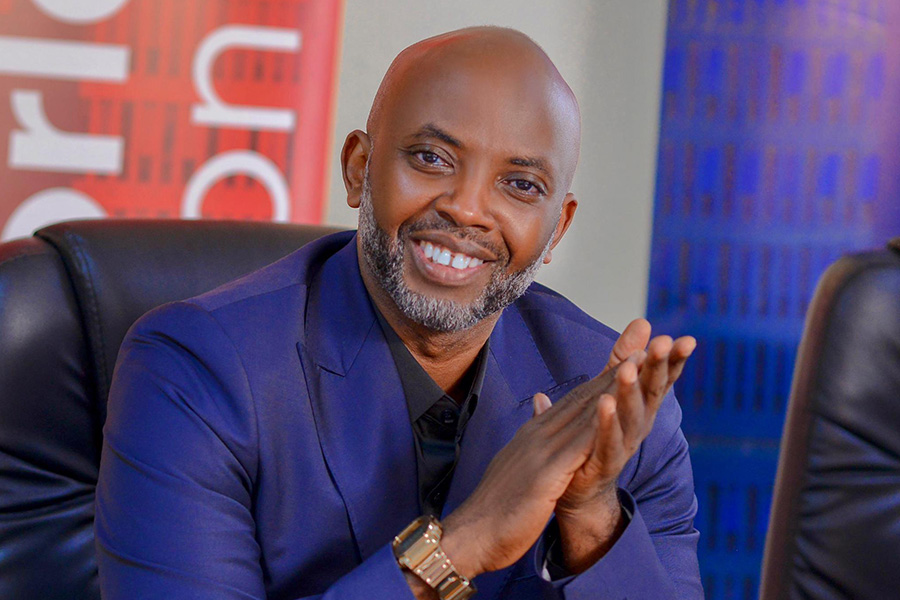
President Museveni’s appointment of Victoria University Vice Chancellor Dr Lawrence Muganga as State Minister for Internal Affairs is facing a formal legal challenge over allegations that he holds dual Ugandan-Canadian citizenship, potentially placing him in conflict with Uganda’s citizenship laws.
The petition, filed by lawyer and Democratic Front Deputy Secretary General Deric Fredric Namakajo, was addressed to Parliament through the office of the Clerk to Parliament and copied to President Museveni and Security Minister Maj Gen Jim Muhwezi.
In the petition dated May 28, 2026, Namakajo argues that Muganga may be legally barred from serving as minister under Section 19D of the Uganda Citizenship and Immigration Control (Amendment) Act, 2009, which restricts dual citizens from holding certain sensitive state offices.
The petitioner wants Parliament, chaired by Speaker Jacob Oboth-Oboth in his capacity as chair of the Appointments Committee, to halt Muganga’s vetting until conclusive proof is produced showing he no longer possesses Canadian citizenship.
“The law expressly bars any dual citizen from serving as Cabinet Minister, Minister of State, or any ministerial office whatsoever,” the petition states.
The challenge places renewed attention on Uganda’s complicated relationship with dual citizenship, sovereignty, and national identity.
Under Ugandan law, dual citizenship itself is permitted. However, the Citizenship and Immigration Control Act bars holders of dual nationality from occupying offices listed in the Fifth Schedule of the law.
These include President, Vice President, Prime Minister, Cabinet Ministers and Ministers of State.
Namakajo argues that the Internal Affairs ministry is especially sensitive because it directly oversees immigration control, citizenship administration, national identification systems, internal security coordination and border management.
“The Ministry of Internal Affairs being responsible for immigration and citizenship matters requires undivided national allegiance and fidelity to the Republic of Uganda,” the petition reads.
Documents circulating on social media show that Muganga only registered for Ugandan citizenship on November 8, 2024, and received his Ugandan passport on February 26, 2026.
Muganga was born in Mukono District in 1976, the documents show.
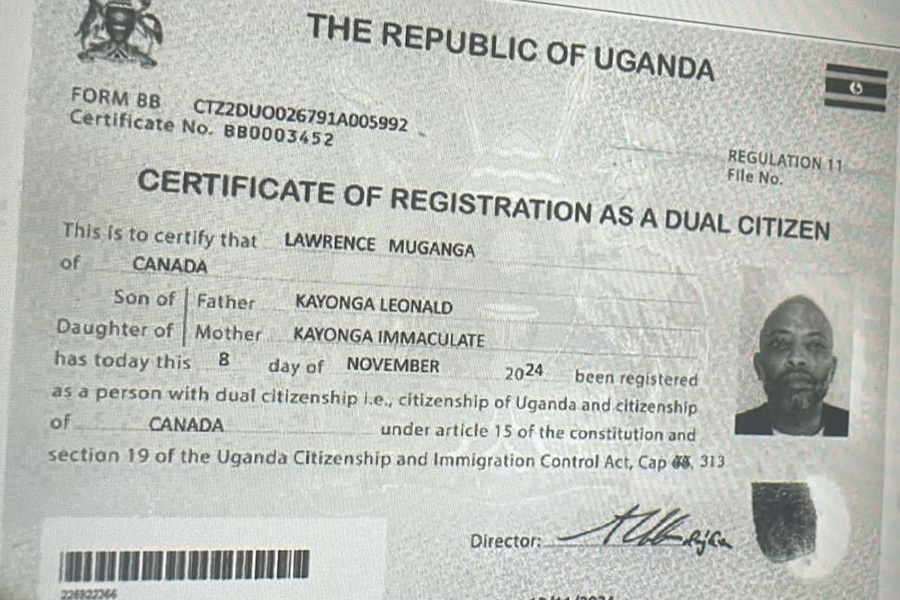
But at the centre of the controversy is his long public association with Canada and previous political scrutiny linked to identity and citizenship issues, including that of southwestern neighbours Rwanda.
But such a framing by the petitioner would place the appointment of Calvin Echodu as junior foreign affairs minister in scrutiny too.
It has been widely reported that Echodu holds dual citizenship with America - although the Nile Post could not independently verify the claims.
Muganga previously worked as a policy advisor for the Government of Alberta and as a project manager at Edmonton Multicultural Coalition in Canada. He also worked with Rwanda Revenue Authority and was identified nationally as a Rwandan.
A May 14, 2013 article published by Rwanda’s New Times newspaper described him as “a Rwandan national currently living and working in Canada” while profiling him after he received recognition from the Alberta provincial government for initiating a crime prevention initiative known as the Injera Project.
The article also identified him as a PhD student at the University of Alberta specialising in educational administration and leadership.
The petition further references Daily Monitor reporting from September 2021 in which immigration authorities reportedly acknowledged that Muganga had obtained dual or multiple citizenship.
That same year, Muganga was dramatically arrested by operatives attached to the Chieftaincy of Military Intelligence and Crime Intelligence at Victoria University amid heightened Uganda-Rwanda tensions.
Security operatives reportedly accused him of espionage and illegal stay in Uganda, although he was never formally charged and was released within days.
At the time, relations between Kampala and Kigali were severely strained, with individuals perceived to have Rwandan links increasingly subjected to scrutiny, citizenship verification pressures and travel restrictions.
Muganga consistently denied wrongdoing and later emerged as a prominent public voice on questions affecting Ugandans of Rwandan heritage, particularly through advocacy linked to the loosely organised Abavandimwe civic movement.
In 2024, Muganga and social commentator Frank Gashumba jointly petitioned Parliament over alleged discrimination against Ugandans of Rwandan origin in access to national identification documents and citizenship verification.
It is this history that has made his appointment to Internal Affairs particularly politically sensitive.
The ministry he has been nominated to help oversee is the very institution responsible for immigration enforcement, citizenship regulation and identity governance — areas in which Muganga himself was once publicly scrutinised.
The petition also arrives only weeks after Museveni assented to the controversial Protection of Sovereignty law, legislation government defended as necessary to shield Uganda from foreign political influence and external interference.
Although the new law primarily targets foreign-backed organisations, external political funding and activities considered capable of undermining national sovereignty, its language and political framing have reignited debate about foreign allegiance, external influence and the role of non-citizen interests within Uganda’s governance structures.
Critics of the law argued during parliamentary debate that some provisions were broad enough to potentially create suspicion around individuals with strong foreign affiliations, international funding networks or transnational political ties.
Supporters, however, defended it as necessary in an era of geopolitical competition and foreign interference.
Against that backdrop, Muganga’s appointment has inevitably become intertwined with wider national anxieties around citizenship, loyalty and sovereignty.
Political analysts say the symbolism is difficult to ignore: a man once arrested as a suspected foreign-linked operative is now being proposed for one of Uganda’s most security-sensitive ministries.
Yet others view the appointment differently.
Some see it as a political rehabilitation of a previously misunderstood academic, while others interpret it as part of Museveni’s long-standing strategy of incorporating influential actors from contested political spaces into state structures.
There is also a growing argument that Muganga’s lived experience with citizenship disputes and identity politics may have made him strategically useful for a ministry that increasingly sits at the centre of emotionally charged debates over nationality and belonging.
The petition asks Parliament to compel production of passport records, citizenship declarations, renunciation certificates and immigration documentation before any vetting proceeds.
Neither Muganga nor State House had publicly responded to the petition by Thursday evening.
If Parliament proceeds with approval without independently verifying his citizenship status, legal analysts warn the appointment could later face judicial review or constitutional challenge.
The controversy may now force Parliament into directly interpreting and applying dual citizenship restrictions in a cabinet approval process for the first time in years, potentially setting a precedent for future appointments involving internationally connected political figures.
